
TechTruth · Part 1 of 2
The AI Wrapper Epidemic - What we learned
After 100+ tech due diligences and 1,000+ decks, the patterns are always the same.
For the past seven years, through Why Commit Capital and as Venture Partner to several funds and family offices, I’ve read and evaluated pitch decks every week. Across more than a decade, that adds up to 1,000+ companies, a hundred-plus diligences, and 25+ investments in deeptech and AI. Every pattern in this piece comes from my own pipeline. I look at deals as both an investor and someone who has been building AI systems for a long time — long enough to know the difference between a real technical foundation and a good story about one. The rule I keep coming back to: don’t trust the headline until you’ve checked what’s actually behind it. The sectors change — ClimateTech, HealthTech, FinTech, DefenceTech — but the tells repeat.
Five patterns that won’t die
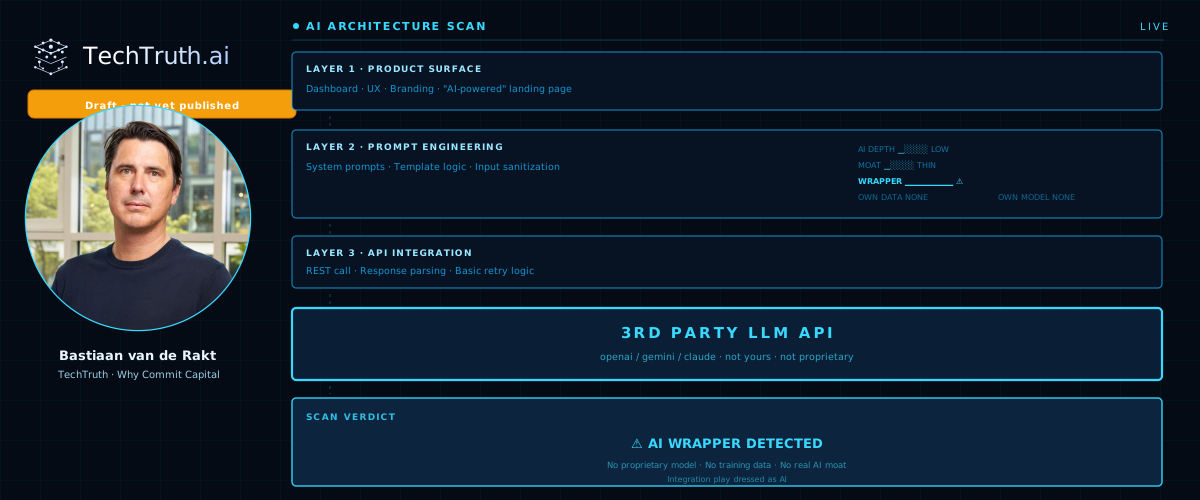
1. The API wrapper dressed as proprietary AI. A thin product on someone else’s model can still be a strong integration story, until the deck sells owned intelligence. That’s a different risk and a different underwriting question, and when founders blur the two, investors who don’t read the stack often reward the wrong bet.
In practice the slide says “proprietary” while the path is a hosted foundation model, structured outputs, and solid application code — without auditable weights, a real eval setup, or a labeled holdout that beats a baseline. I respect that build for what it is; I just won’t treat it as the training loop until the language matches what’s in git and in the infra graph.
2. The founder who “built AI” but can’t explain the training data. I keep asking where labels come from, who holds rights, and what breaks first when reality moves. Founders who can spell that out earn the intelligence narrative; founders who can’t are asking you to trust a press release.
Public corpora are fine as a starting point, but I still need lineage and rubric, clean separation between train and validation, rights that cover your derivatives, and a credible plan for when feeds or schema shift. If the whole answer is “we download open data,” you’re citing sources — not yet telling a moat story.
3. The architecture diagram that pretends machines run alone. A clean diagram doesn’t remove drift, quiet failure, or the question of who owns a bad week in production. When logging, rollback, and human review are missing, the drawing is aspiration more than architecture.
In diligence I’ll ask for request tracing, pinned model versions, canary or shadow paths, rollback you can name (which artifact, which traffic split), and at least a direction of travel on drift or quality on live inputs. Living out of a notebook is normal early on, but I still need a believable bridge to something operationally serious before I buy the production claim.
4. The human-in-the-loop who doesn’t understand the domain. Oversight without domain judgment isn’t really oversight — clinical AI with no clinical depth, industrial AI with no one who’s walked the line, forecasting with no one who understands the grid. If the human can’t recognize a wrong output, you have paperwork, not control.
I’ve seen “human review” where nobody could say what a materially wrong answer looks like, with no rubric, no veto rules, and no sampling of real failure modes. That clears SLAs without touching tail risk. What helps is domain vocabulary and escalation tied to outcomes — not another approver who can’t tell error from noise.
5. The founding team that doesn’t match the thing they’re building. Pedigree is not the same as fit. I’ve watched PMs claim AI depth from proximity to models, adjacent exits get reframed as domain expertise, and teams with two strong engineers but no one who truly carries the customer or the regulator. The real question is whether this group can ship this product when someone pushes on it, not whether the logos sparkle — and in a market where talking AI got cheap, proving you can build it only got slower.
Even strong architecture needs someone who shaped the error taxonomy with the people who live the workflow; otherwise you get vague labels, brittle prompts, and no gold set that reflects how things actually fail. That gap is usually fixed with depth and time in the field, not by adding headcount for its own sake.
These patterns are old news; what’s new is the cheque size behind them.
Across 759 pitchdecks processed through TechTruth, 71% had no genuine AI asset under the claim, and 59% had at least one founder credential that didn’t line up with LinkedIn, the company website, or public records. The vertical changes; the pattern doesn’t.
Everyone sees it now
Google’s Darren Mowry called out wrappers and aggregators as being on warning lights, and YC pushed back with the familiar “MySQL wrapper” comparison — which is fair when the product genuinely adds depth at the application layer, as with Cursor or Harvey. The companies that last tend to own workflow, domain data, and integration; the thin ones increasingly show up in shutdown data and in failed pilots. The correction isn’t around the corner — it’s here — portfolios just register it late.
This is where the wrapper problem runs into governance. We’ve slid from an AI graveyard, where most builds never reached production, into something messier: a jungle of live systems, multiplying faster than anyone can map, with weak central visibility — and that’s where liability concentrates. Depth turns governance into an advantage; thin positioning turns it into an existential risk. The EU AI Act didn’t create that tension; it simply makes it actionable.
I built TechTruth out of roughly twenty years of building, auditing, and investing: the first-pass diligence I used to run entirely in my head, now written down, objectified, and automated so others get the same scaffolding without waiting on my calendar. Investors can run it as an engine underneath their own process — bake in your review methodology and thesis focus so the human-in-the-loop step carries your partnership’s expert judgment and house standards, not a generic rubric off the shelf. Founders can use it to challenge and stress-test a deck before the roadshow, and surface the weak spots in private instead of in a first meeting. Each pass still teaches the system; I still insist on real expert review on what goes out, because diligence without that loop is the thing this piece warns against. The shared baseline remains verification against LinkedIn, company sites, and whether there is real model substance or mainly integration. The product is in beta — it gets a little better every day — and I’m upfront that this is a beginning, serious but still early. First audit is free — try it here →
The wrapper story didn’t end; it moved. Part 2 (Coming Soon) tracks where it went, and what I’m seeing in decks today.
About the author: Bastiaan van de Rakt founded Why Commit Capital and is Venture Partner to several international funds and family offices. He is Operating Partner at Volve Capital and Venture Partner at Aenu; co-founded INIT8 (exited 2011), Enjins, and Deeploy. Twenty-five years in AI build, invest, and audit; 1,000+ decks, 100+ tech diligences. Building TechTruth. About → · LinkedIn →
Building something real? If you recognized your deck here, that’s a good sign. Genuine AI depth in Climate or deep tech, pre-seed–A — I want the conversation, not to audit you. Let’s talk →